
LwM2M protocol introduction
LwM2M protocol is the lightweight M2M protocol established by OMA; it mainly faces the IOT application of honeycomb-based NB-IoT and focuses on Low Power Wide Area (LPWA) IOT market; it’s an emerging technology that can be extensively used in the whole world. It has the features of wide coverage, multiple connections, low rate, low cost, low power consumption, and optimal structure.
Features
| NB-IoT has four features: |
Wide coverage: under the same wave band, NB-IoT has a transmission gain 20dB more than that of the current network, which is equivalent to the expansion of the coverage area by 100 times.
Wide connection: it can support the connection of a great deal of device, and has the ability to support wide connections. One sector of NB-IoT can support 100,000 connections;
Low-power dissipation: it focuses on the application occasions with a small data volume and small rate, especially some device and occasions for which batteries can’t be replaced frequently; theoretically, the stand-by time of NB-IoT terminal module can be as long as 10 years;
Low cost: It’s expected the cost of a single connection module won’t exceed 5 US dollars.
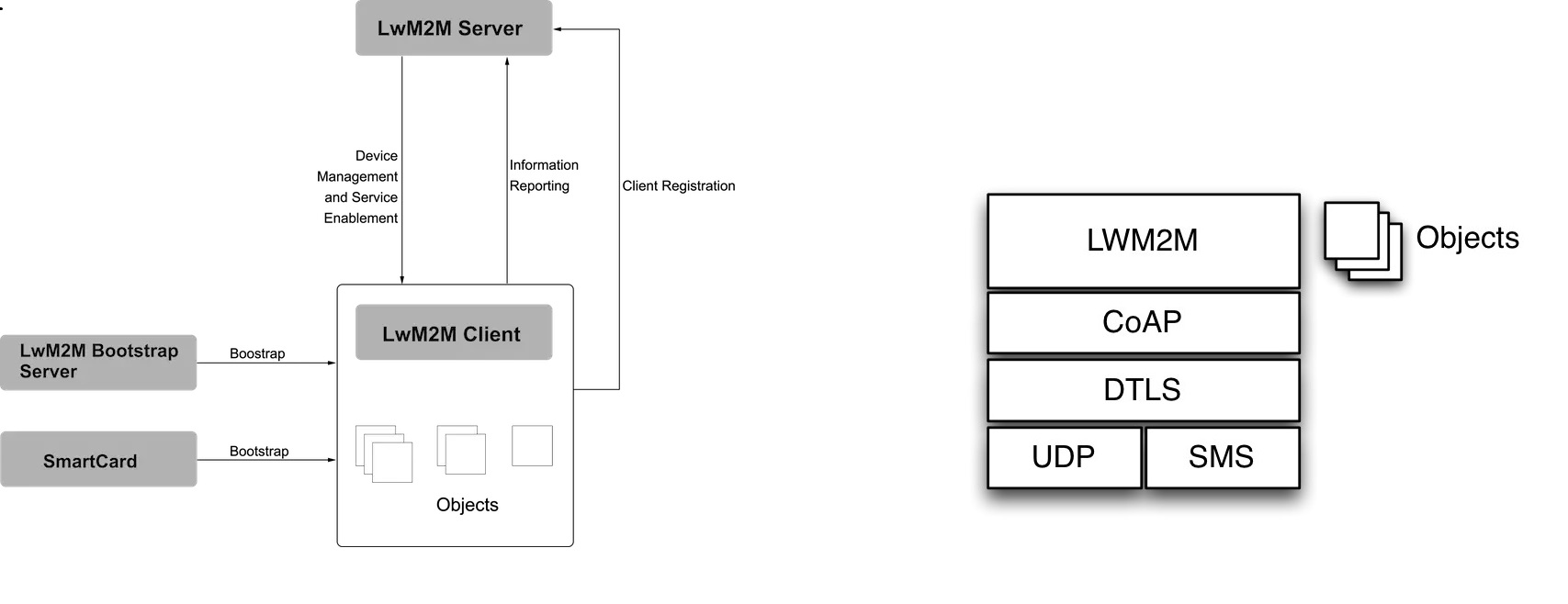
LwM2M protocol based on NB-IoT and Coap protocol can realize the communication between UE and OneNET platform; wherein, in the data transmission protocol, the transmission layer protocol is Coap and the application layer protocol is LwM2M.
| Coap protocol has the following features: |
Based on lightweight UDP protocol, with a retransmission mechanism.
The protocol supports IP multicast.
The protocol header is small and only contains 4 bytes.
Low power consumption, applicable to low-power dissipation IOT.
| LwM2M protocol is applicable to lightweight protocol and different IOT devices; LwM2M defines three logical entities. |
- LwM2M Server
- LwM2M client side, responsible for implementing the server order and reporting the implementation result;
- LwM2M guides server Bootstrap Server, responsible for configuring LwM2M client side
LwM2M protocol architecture and protocol suite are as shown in the figure below:
Protocol resource definition
Please refer to the object and resource